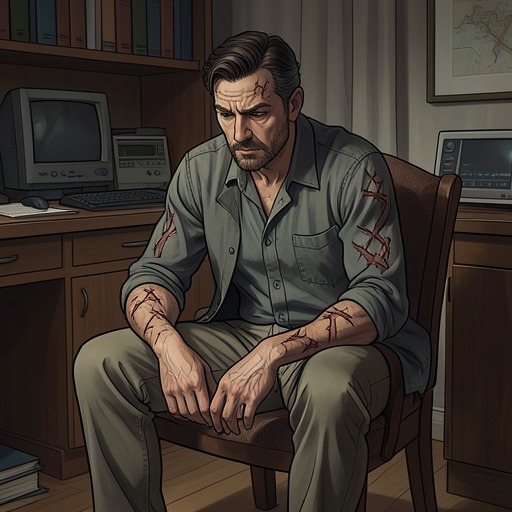
Ollie shows Shay his burn scars
The Edge of the WorldOllie shows Shay his burn scars at a turning point in their intimacy: after resisting Shay’s questions about why he no longer plays guitar, he removes his clothes and lets Shay see the body he has kept shielded. The disclosure makes vulnerability physical. Ollie does not explain everything that happened in the accident; instead, he lets Shay look, and then places Shay’s hand on the worst of the scars. Their exchange tests whether being seen will change the care between them, and Ollie’s eventual return to Shay’s embrace answers that fear without erasing it.
Background and Conflict
The scene grows out of an imbalance Shay can no longer ignore. He reminds Ollie that he has seen Shay at his worst repeatedly, while Ollie will not explain why he stopped playing guitar. Ollie deflects, first minimizing his ability as a musician and then treating the guitar as if it were the whole issue. Shay insists that the question is really about what Ollie refuses to share. His anger is therefore also a plea for mutual trust: he does not want to remain exposed to Ollie while being shut out of a part of Ollie’s life that matters.
Shay makes that plea concrete by comparing Ollie’s silence with his own diabetes. He has to calculate whenever he eats a sandwich, and Ollie already knows what happens when managing it goes wrong because he has seen the consequences. Shay asks Ollie to imagine the reverse: knowing that something shapes a person’s whole life while being denied the trust of seeing it. The comparison does not equate their experiences; it identifies the loneliness of being known only on one person’s terms. Shay also admits that Ollie’s evasions hurt him, while worrying that pressing further might make Ollie’s life harder. The disclosure follows from that conflict, not from a calm request for a full account.
The Disclosure
Ollie first responds by kissing Shay. The narration distinguishes this kiss from an attempt to silence him: Shay’s words have begun to get through Ollie’s defenses. Ollie focuses on the sensation of Shay’s wet skin and counts his breaths, using the immediate physical moment to steady himself. His attention narrows, a response the narration connects to the way he has focused since childhood and before and after the accident that changed him. This pause gives the scene its hinge: Ollie does not yet tell the story, but he begins to stop retreating from the person asking to hear it.
He guides Shay’s hand to the zipper of his hoodie and makes him draw it down. Under it, Ollie is still wearing a Bob Dylan T-shirt, so the first opening does not yet reveal the scars. He then pulls the shirt over his head. The action is deliberate and exposed: Ollie stands bare in the kitchen, under Shay’s gaze, while cutting remarks come to mind and remain unsaid. Instead of controlling what Shay sees through a joke or an explanation, he lets the silence hold the moment. The scene’s focus shifts from what Ollie might say about himself to the visible body he has so far kept from Shay.
Witness and Response
Ollie takes Shay’s hand and places it on the thickest scars. These scars had obscured his protruding ribs when he lost weight after the accident. The detail gives the disclosure a specific physical history: Shay is not being shown an abstract mark or a carefully chosen image, but the damaged skin that accompanied Ollie’s loss of weight. Ollie calls this body himself and asks Shay to let the matter go. The request carries both an assertion and a retreat. He has made himself visible, but he still hopes to close down the questions that brought them there.
He steps back, letting Shay’s hand slip away, and walks off. For a moment, the disclosure seems to produce distance rather than reassurance. Yet Ollie turns back. He kisses Shay three times and explains that he acted because he knew what they shared was real but needed to be sure. The scene clarifies that the exposure was also a test of whether Shay would still want closeness after seeing him. Shay answers by holding Ollie around the waist and telling him that he cares, even when Ollie behaves badly; the scars do not cancel that care. Their renewed kisses and wandering hands bring them close again, until Shay sways on his feet and interrupts the growing intimacy.
Significance
The event makes trust reciprocal without presenting disclosure as effortless or complete. Shay’s comparison to the visible consequences of his diabetes gives Ollie a way to understand why secrecy hurts; Ollie’s response is not a full account of his accident, but an act of showing. The scars become evidence of what he has endured and of what he fears Shay might see, while Shay’s hand makes witnessing an intimate, chosen action rather than detached observation.
The sequence also preserves the risk in Ollie’s gesture. He exposes himself, asks Shay to stop asking, withdraws, and only then returns to explain that he needed reassurance. Acceptance does not instantly settle every question: Shay has seen the scars, but the scene does not claim that Ollie has narrated their entire history or resolved his trauma. What changes is the relation between concealment and touch. Once Shay has seen the body Ollie feared exposing, Ollie can choose to come back to him, and their physical closeness resumes on more honest terms.